Choosing a DTF printing company is about more than comparing prices. Print quality, turnaround time, transfer durability, and production consistency can all affect your business.
Whether you order custom transfers occasionally or purchase them in volume, asking the right questions before placing an order can prevent expensive problems later. This guide covers 12 important questions every buyer should ask a DTF printing company before making a decision.
1. What Type of DTF Transfers Do You Offer?
Start with the basics. Ask what products and ordering options the supplier provides.
For example, you may need:
- Individual custom transfers
- Ready-to-press transfers
- Custom-sized designs
- Multi-design sheets
- Bulk production
- Reseller or fulfillment support
If you have multiple designs or smaller graphics, ask whether the company offers DTF gang sheet printing. Gang sheets can help organize several designs on one sheet and may reduce material waste.
The best option depends on your artwork, order size, and production process.
2. How Consistent Is Your Print Quality?
A transfer may look great in a product photo but perform differently in real production. Ask how the supplier maintains consistency between orders.
Important areas include:
- Color accuracy
- Fine-detail reproduction
- White ink coverage
- Smooth gradients
- Small text clarity
- Edge sharpness
This is especially important for brands that reorder the same logo or design. Small color differences can make uniforms or merchandise look inconsistent.
Ask whether the supplier uses a defined production process for repeat orders. If possible, test a sample before placing a large order.
3. How Durable Are the Transfers After Washing?
Durability is one of the most important questions to ask a DTF printing company.
Ask how the transfers perform after repeated washing and wearing. A good transfer should remain properly bonded when applied according to the recommended instructions.
You should also ask about:
- Recommended washing methods
- Expected resistance to cracking or peeling
- Fabric compatibility
- Whether durability depends on correct heat press settings
Keep in mind that transfer quality is only one part of the result. Incorrect temperature, pressure, or pressing time can also cause failures.
4. What Heat Press Settings Do You Recommend?
Every supplier should provide clear application instructions.
Ask for recommended settings for:
- Temperature
- Pressing time
- Pressure
- Peel method
- Final press requirements
You should also check whether settings vary by fabric type. Cotton, polyester, blends, and performance fabrics may require different approaches.
Clear instructions reduce guesswork and help your team achieve consistent results.
5. Can You Handle My Artwork Properly?
Artwork quality has a direct impact on the finished transfer. Before ordering, ask what file types the company accepts and whether artwork is reviewed before production.
Questions to consider include:
- Do you accept PNG, PDF, SVG, or AI files?
- Is a transparent background required?
- What resolution is recommended?
- Are small details checked before printing?
- Will you notify customers about obvious artwork issues?
If you regularly order logos or branded artwork, reliable direct to film DTF custom transfers can simplify the process.
However, the supplier should still provide clear artwork requirements before production begins.
6. What Is Your Actual Turnaround Time?
Do not only ask for a general delivery estimate. Ask how long production takes before shipping.
A useful question is: When will my order leave your facility after approval?
Also ask about:
- Standard production time
- Rush order availability
- Cutoff times
- Shipping options
- Possible delays during busy periods
This matters for print shops working with customer deadlines. A supplier may offer fast shipping, but slow production can still delay the final order.
7. What Happens If There Is a Print Problem?
Mistakes can happen in any production process. What matters is how the company handles them.
Before ordering, understand the process for issues such as:
- Incorrect prints
- Missing items
- Damaged transfers
- Production defects
- Shipping damage
Ask whether photos or other evidence are required and how quickly claims are reviewed.
A clear issue-resolution process can be especially valuable when you have a time-sensitive customer order.
8. Do You Offer Pricing for Larger Orders?
As your order volume increases, your buying requirements may change.
Ask whether the supplier provides options for bulk and wholesale DTF printing. Larger orders may require different pricing structures, production schedules, and packaging options.
It is also worth asking about:
- Volume-based pricing
- Minimum order quantities
- Repeat order programs
- Pricing for common sizes
- Production capacity for ongoing orders
The lowest unit price is not always the best deal. Consistent quality and reliable turnaround can have greater value for a growing business.
9. Can You Handle Large or Repeat Orders Consistently?
A company may handle a small test order well but struggle with larger production runs.
Ask about production capacity if you expect recurring orders. This is particularly important for apparel brands, print shops, event companies, and promotional businesses.
Consider asking:
- Can you support weekly or monthly orders?
- How do you maintain color consistency?
- Are repeat designs stored accurately?
- What happens during seasonal demand?
- Can you scale production when needed?
Reliable capacity becomes more important as your business grows.
10. Do You Offer White Label Production?
If you sell transfers under your own business name, white label services may be useful.
A white label DTF printing service can support businesses that want to outsource production while maintaining their own customer-facing brand.
Before choosing this option, ask about:
- Plain or custom packaging
- Packing slips
- Direct-to-customer shipping
- Branding visibility
- Order handling procedures
This model can be useful for resellers and businesses that want to focus on sales rather than operating printing equipment.
11. How Easy Is It to Reorder?
Reordering should not require restarting the entire process.
Ask whether the company makes repeat orders simple. This is helpful when you frequently reorder the same logos, graphics, or customer designs.
A smooth reorder process can reduce:
- Artwork mistakes
- Ordering time
- Approval delays
- Inconsistent sizing
- Production confusion
For recurring designs, consistency should be just as important as convenience.
12. Can You Support My Business as It Grows?
Finally, think beyond your current order.
The right DTF printing company should fit your future needs as well as your present ones. A small apparel business may eventually need larger orders, more designs, faster production, or reseller support.
Ask whether the supplier can adapt as your requirements change.
A dependable production partner can help reduce operational pressure. For example, DTFS.co can be evaluated based on the same factors discussed above, including product options, ordering needs, and production support.
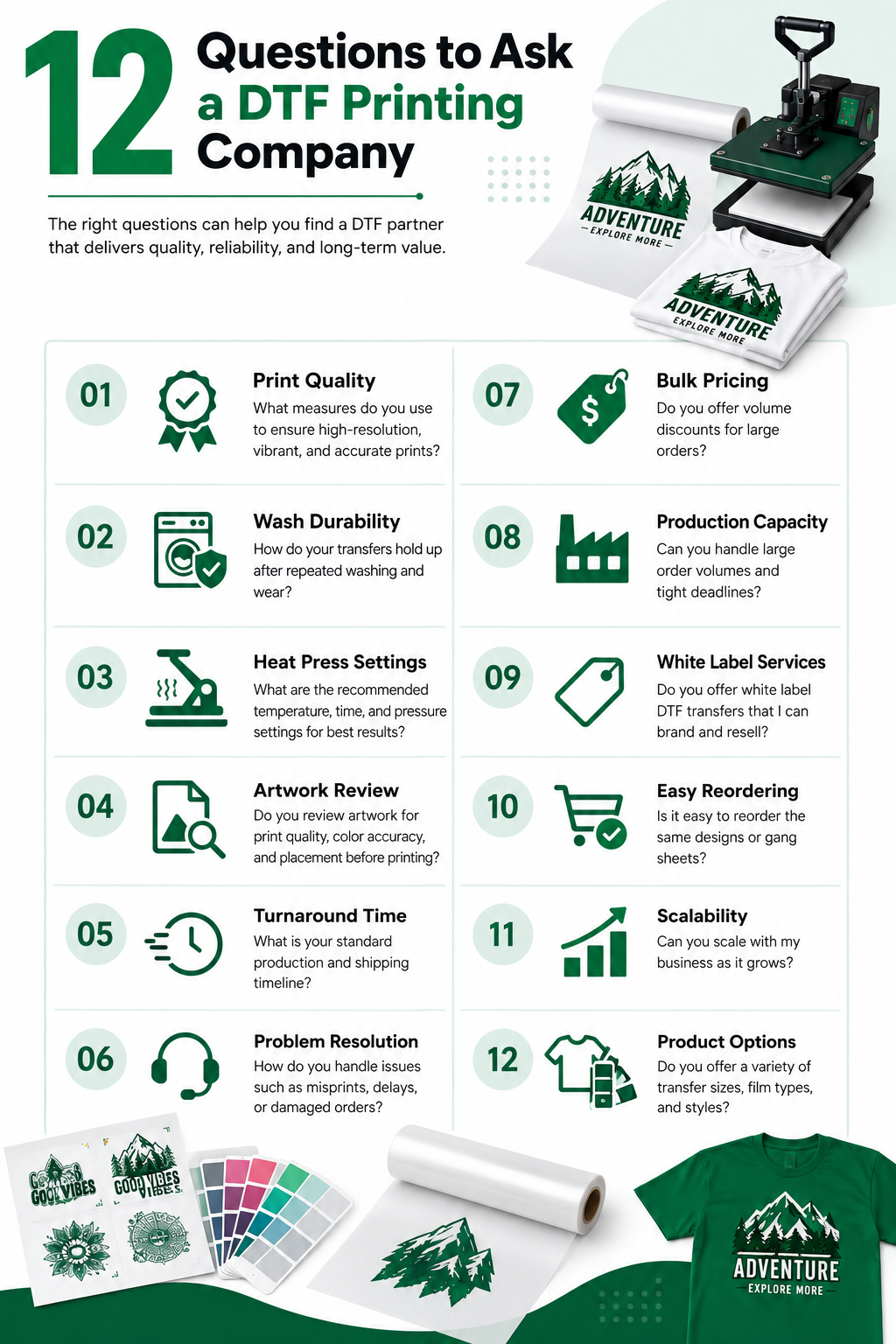
Quick Comparison: What to Check Before Choosing a DTF Printing Company
| Buying Factor | Question to Ask |
| Print quality | How do you maintain color and print consistency? |
| Durability | How do transfers perform after repeated washing? |
| Application | What heat press settings do you recommend? |
| Artwork | Do you review files before production? |
| Turnaround | How long does production take before shipping? |
| Problem handling | What happens if my order has a defect? |
| Bulk orders | Do you offer volume pricing and production support? |
| Capacity | Can you handle recurring and larger orders? |
| White label | Do you offer reseller-friendly fulfillment options? |
| Reordering | Can previous designs be reordered easily? |
| Scalability | Can your service support future growth? |
Conclusion: Choose a DTF Printing Company by Asking Better Questions
Finding the right DTF printing company should involve more than comparing transfer prices.
Ask about quality, durability, artwork handling, application instructions, turnaround times, bulk capacity, and support. These details can make a major difference when you are producing products for customers.
Start with a smaller order when possible, evaluate the results, and then scale based on quality and reliability. The right supplier should make your production process easier, more predictable, and better prepared for growth.